
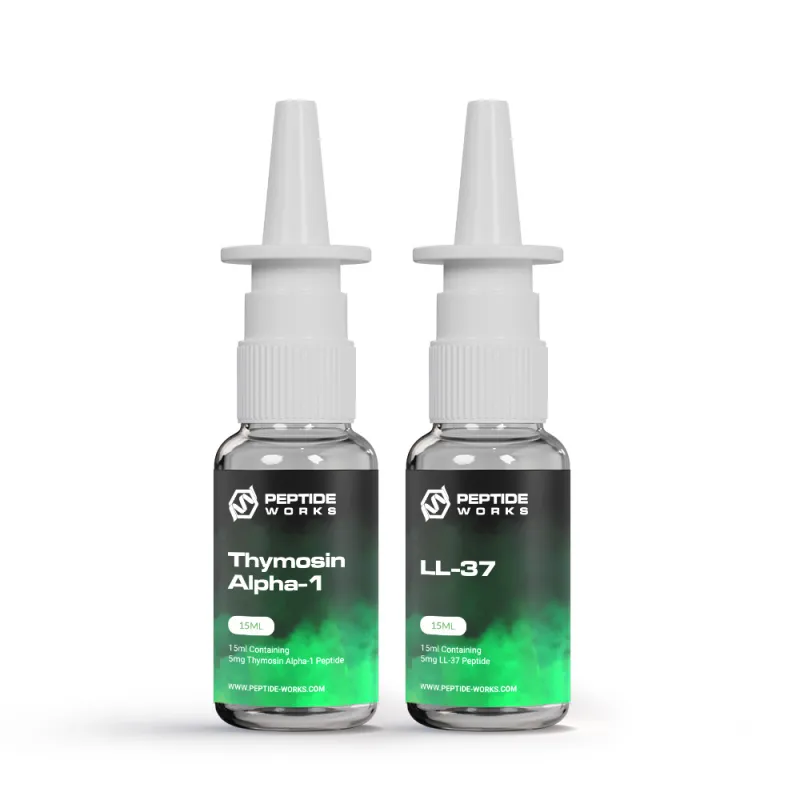
Buy Thymosin Alpha-1 LL-37 Nasal Stack In Europe
Running immune and antimicrobial research? Get the Thymosin Alpha-1 LL-37 Nasal Stack in Europe ready to use.
At Peptide Shop Europe we supply high-purity Thymosin Alpha-1 + LL-37 in a combined nasal format. No reconstitution needed, every bottle ships with full COA.
Where to buy Thymosin Alpha-1 LL-37 Nasal Stack in the EU? From our EU warehouse with 48H delivery to UK, Germany, France and across Europe.
Can I purchase Thymosin Alpha-1 LL-37 Nasal Stack online? Yes. You can order Thymosin Alpha-1 LL-37 Nasal Stack, shop Thymosin LL-37 nasal peptides, or get Thymosin + LL-37 nasal combo from EU stock today.
Labs across Europe trust Peptideshopeurope to purchase pharmaceutical-grade Thymosin Alpha-1 and LL-37 for immune and innate defense studies. Verified purity, discreet shipping, and fast dispatch so you can stock your lab with Thymosin Alpha-1 LL-37 Nasal Stack in Europe.
Thymosin Alpha-1 LL-37 Nasal Stack: Overview
Thymosin Alpha-1 LL-37 Nasal Stack refers to an experimental peptide combination involving thymosin alpha-1 (Tα1) and LL-37, two biologically active peptides associated with immune regulation and host-defense research.
Thymosin alpha-1 is a 28-amino-acid peptide that has been investigated for its effects on innate and adaptive immune responses. LL-37 is the only human cathelicidin and is studied extensively for its antimicrobial, immunomodulatory, and tissue-response properties.
The term nasal stack describes a formulation or product concept combining the two peptides for nasal delivery. It should not be interpreted as evidence that the combination has been clinically validated, approved, or demonstrated to provide superior effects compared with either peptide individually.
What Is Thymosin Alpha-1 LL-37 Nasal Stack?
A Thymosin Alpha-1 LL-37 Nasal Stack combines two peptides with different but potentially complementary biological roles.
Thymosin alpha-1 is primarily studied as an immunomodulatory peptide. Research has examined its influence on T-cell function, dendritic cells, innate immune signaling, and immune responses to infections.
LL-37 is an endogenous antimicrobial peptide belonging to the cathelicidin family. It can interact directly with microbial membranes while also influencing inflammatory and immune signaling. (ScienceDirect)
Because their mechanisms are different, researchers may be interested in studying their combined effects. However, evidence specifically supporting a combined nasal Tα1/LL-37 preparation remains limited.
Thymosin Alpha-1: Biological Role
Thymosin alpha-1 is naturally associated with the thymus and has been extensively investigated as an immunomodulatory peptide.
Research suggests that Tα1 can influence several components of immune function, including:
- T-cell activity
- Dendritic-cell function
- Toll-like receptor signaling
- Cytokine production
- Antigen presentation
- Innate immune responses
A comprehensive review of Tα1 research describes its broad immunomodulatory activity and extensive clinical investigation across infectious and immune-related conditions.
LL-37: Biological Role
LL-37 is derived from the human cathelicidin antimicrobial peptide (CAMP) precursor.
It is part of the body’s innate defense system and has been studied for its activity against a variety of microorganisms.
LL-37 research has identified several biological functions, including:
- Antimicrobial activity
- Biofilm-related activity
- Immune-cell signaling
- Inflammatory modulation
- Chemotaxis
- Tissue-repair responses
Importantly, LL-37 can have both inflammatory and anti-inflammatory effects depending on the biological environment, concentration, and cellular context.
Thymosin Alpha-1 LL-37 Nasal Stack: How the Peptides Differ
| Peptide | Primary research area | General biological role |
|---|---|---|
| Thymosin alpha-1 | Immunology | Immune modulation |
| LL-37 | Host defense | Antimicrobial and immunomodulatory activity |
This distinction is important when evaluating a Thymosin Alpha-1 LL-37 Nasal Stack. The two peptides are not interchangeable and do not act through an identical molecular mechanism.
Thymosin Alpha-1 LL-37 Nasal Stack and Immune Research
The combination is scientifically interesting because it brings together immune modulation and innate antimicrobial defense.
Thymosin alpha-1 has been investigated in clinical studies involving infectious diseases and immune dysfunction. A large phase-3 randomized trial in patients with sepsis evaluated Tα1 alongside standard care; the trial provides a useful example of why individual clinical evidence should be assessed according to the specific disease and treatment setting rather than generalized to every proposed application.
LL-37, meanwhile, has primarily attracted attention through laboratory, animal, and early translational research. Reviews describe antimicrobial and immunomodulatory properties while also highlighting challenges involving stability, toxicity, and delivery.
Nasal Delivery Research
The nasal route is being investigated for peptide delivery because the nasal mucosa can provide an alternative administration pathway.
However, nasal delivery introduces formulation-specific considerations, including:
- Peptide stability
- Mucosal absorption
- Enzymatic degradation
- Nasal clearance
- Formulation excipients
- Concentration
- Delivery-device characteristics
Evidence obtained from one nasal peptide formulation cannot automatically be applied to another.
Research involving Tα1 and nasal administration has existed in specific experimental contexts, but this should not be confused with clinical validation of a combined Thymosin Alpha-1 LL-37 Nasal Stack.
Immune-System Research
Tα1 is investigated for its ability to influence innate and adaptive immune responses.
Antimicrobial Peptide Research
LL-37 is a major model for studying endogenous antimicrobial peptides and host defense.
Inflammatory Signaling
Both peptides have been investigated in relation to inflammatory signaling, although their mechanisms and effects differ.
Host-Defense Research
The combination provides an experimental framework for studying how immune modulation and antimicrobial defense might interact.
Peptide Delivery Research
A nasal formulation can also serve as a research model for investigating non-invasive delivery of biologically active peptides.
Evidence and Limitations
The evidence base for the individual peptides is substantially larger than the evidence specifically supporting their combined nasal administration.
Important limitations include:
- There is limited clinical evidence for the specific combination.
- The optimal nasal formulation has not been established.
- Long-term safety of combined nasal exposure is uncertain.
- LL-37 can produce context-dependent inflammatory effects.
- Results from laboratory and animal models cannot automatically be translated to humans.
- Product quality can vary considerably between preparations.
Consequently, a Thymosin Alpha-1 LL-37 Nasal Stack should be described as an experimental peptide formulation rather than as a clinically established immune or antimicrobial treatment.
Product Quality and Documentation
For a prepared nasal peptide combination, product-specific documentation is particularly important.
Relevant information may include:
- Thymosin alpha-1 identity
- LL-37 identity
- Concentration of each peptide
- Purity analysis
- Batch or lot number
- Formulation ingredients
- Manufacturing information
- Stability data
- Storage requirements
- Expiration or retest date
- Certificate of analysis, where available
A certificate of analysis can provide batch-specific analytical information but does not independently establish clinical efficacy, safety, or regulatory approval.
Safety and Important Considerations
Because both peptides influence biological processes, the safety profile of a combined formulation cannot be inferred simply from their natural occurrence in the human body.
For Tα1, clinical research has provided substantially more safety information than exists for many experimental peptides. Nevertheless, outcomes vary according to the indication, formulation, population, and treatment context. A recent large sepsis trial, for example, reported no unexpected serious adverse events attributable to Tα1 but did not establish the nasal combination discussed here.
LL-37 presents additional formulation and safety questions. Reviews have identified concerns involving proteolytic degradation, bioavailability, and potential toxicity that complicate its translation into therapeutic products.
Regulatory Considerations
The regulatory status of the individual peptides should be distinguished from the status of a Thymosin Alpha-1 LL-37 Nasal Stack.
Thymosin alpha-1 has undergone extensive clinical development in several countries, but regulatory status differs by jurisdiction and indication. LL-37 remains primarily an investigational antimicrobial and immunomodulatory peptide.
There is therefore no basis for assuming that a combined Tα1/LL-37 nasal formulation has the same regulatory status as any individual peptide preparation.
Frequently Asked Questions About Thymosin Alpha-1 LL-37 Nasal Stack
What is Thymosin Alpha-1 LL-37 Nasal Stack?
It is a term describing a combination of thymosin alpha-1 and LL-37 formulated or marketed for nasal delivery.
What is thymosin alpha-1?
Thymosin alpha-1 is a 28-amino-acid immunomodulatory peptide studied extensively for its effects on immune-system signaling.
What is LL-37?
LL-37 is the principal human cathelicidin antimicrobial peptide. It participates in innate host defense and has additional immunomodulatory functions.
Do thymosin alpha-1 and LL-37 work in the same way?
No. Tα1 primarily acts as an immunomodulator, while LL-37 is an antimicrobial peptide with both direct and indirect effects on host defense.
Has the combined nasal stack been clinically proven?
There is insufficient evidence to establish the specific Thymosin Alpha-1 LL-37 Nasal Stack as a clinically proven combination.
Is the nasal formulation an approved medicine?
The regulatory status depends on the exact product and jurisdiction. A peptide combination marketed as a nasal stack should not automatically be treated as an approved pharmaceutical product.
Scientific References and Informative Sources
- PubMed — Thymosin Alpha-1: Comprehensive Review
- PubMed — Thymosin Alpha-1 Clinical Experience
- PubMed — Thymosin Alpha-1 Sepsis Evidence
- ScienceDirect — LL-37 Antimicrobial and Immunomodulatory Research
- ScienceDirect — LL-37 Delivery Systems
Summary
Thymosin Alpha-1 LL-37 Nasal Stack combines two distinct research peptides involved in host defense and immune regulation. Thymosin alpha-1 has been investigated extensively for immunomodulatory effects, while LL-37 is an endogenous antimicrobial peptide with additional roles in inflammation and tissue biology.
The individual peptides have meaningful scientific literature, but evidence specifically establishing a combined nasal formulation as safe, effective, or synergistic remains limited. For accurate product information, the preparation should therefore be characterized as an experimental peptide combination, with claims kept separate from findings established in individual clinical or laboratory studies.
ALL CONTENT AND PRODUCT INFORMATION AVAILABLE ON THIS WEBSITE IS FOR EDUCATIONAL PURPOSES ONLY.
DISCLAIMER: Products are supplied for research purposes only and are not intended to diagnose, treat, cure, or prevent any disease.