
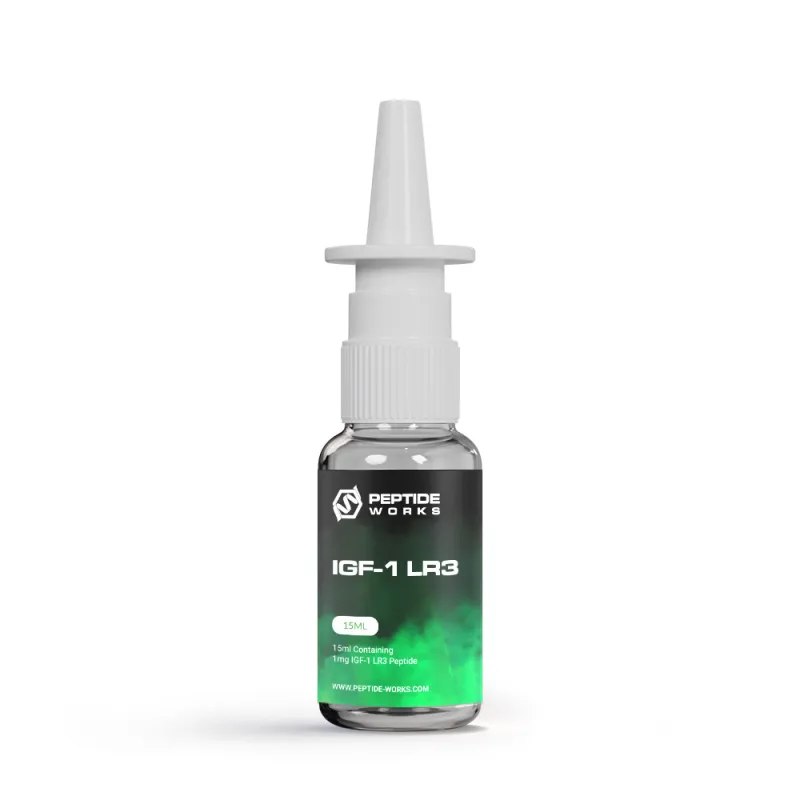
Buy IGF-1 LR3 Nasal Spray In Europe
Running growth factor research and need IGF-1 LR3 Nasal Spray in Europe? This is it.
At Peptide Shop Europe we supply lab-grade IGF-1 LR3 in a ready-to-use nasal format. No reconstitution required.
Where to buy IGF-1 LR3 Nasal Spray in the EU? From our EU warehouse with 48H delivery to UK, Germany, France and across Europe. Every bottle is lab-tested and ships with full COA documentation.
Can I purchase IGF-1 LR3 Nasal Spray online? Yes. You can order IGF-1 LR3 Nasal Spray, shop IGF-1 LR3 research peptide, or get IGF-1 LR3 nasal peptide from EU stock today.
Researchers across Europe trust Peptideshopeurope.com to purchase high-purity IGF-1 LR3 Nasal Spray for cellular and growth factor studies. Fast dispatch, discreet packaging, and verified purity so you can stock your lab with IGF-1 LR3 Nasal Spray in Europe.
IGF-1 LR3 Nasal Spray: Overview
IGF-1 LR3 Nasal Spray refers to a nasal-delivery preparation associated with Long R3 IGF-1 (LR3-IGF-1), a modified analogue of insulin-like growth factor-1 (IGF-1).
IGF-1 LR3 is structurally modified from native IGF-1. The modifications include an N-terminal extension and an arginine substitution at position 3, changes that reduce its interaction with IGF-binding proteins while retaining activity at the IGF-1 receptor. FDA records identify IGF-1 LR3 as “Long-(Arg3) Insulin-like Growth Factor-I,” while noting that inclusion in the FDA substance database does not imply regulatory approval.
The nasal spray format represents an experimental delivery approach. Importantly, evidence concerning intranasal LR3-IGF-1 is substantially more limited than the evidence concerning native IGF-1 biology.
What Is IGF-1 LR3 Nasal Spray?
IGF-1 LR3 Nasal Spray describes a formulation intended to deliver Long R3 IGF-1 through the nasal route.
Native IGF-1 is a naturally occurring growth factor involved in cellular growth, differentiation, survival, metabolism, and tissue regulation. LR3-IGF-1 was developed as a modified IGF-1 analogue with altered binding characteristics.
The term nasal spray describes the delivery format. It does not establish the concentration, purity, sterility, stability, bioavailability, or regulatory status of a particular preparation.
IGF-1 LR3 Nasal Spray: How It Works
IGF-1 LR3 acts through the insulin-like growth factor-1 receptor (IGF-1R).
A simplified pathway is:
IGF-1 LR3 → IGF-1 receptor → intracellular signaling → cellular growth and survival pathways
IGF-1R activation can influence pathways involved in cell growth, protein synthesis, metabolism, and cellular survival.
The structural modifications in LR3-IGF-1 were designed partly to reduce binding to IGF-binding proteins. Experimental work has therefore used Long R3 IGF-1 to investigate IGF-1 signaling under conditions that differ from native IGF-1 physiology.
IGF-1 LR3 Nasal Spray and Intranasal Research
Research specifically examining intranasal LR3-IGF-1 remains predominantly preclinical.
A recent study investigated intranasal LR3-IGF-1 in a mouse model of Alzheimer’s disease. The researchers administered the compound intranasally for seven months and observed changes in amyloid-plaque characteristics and body composition. However, the treatment did not significantly preserve cognitive performance or memory in the model. (PubMed)
This study demonstrates that intranasal LR3-IGF-1 is being investigated experimentally, but it does not establish effectiveness in humans.
Research Areas
IGF-1 Receptor Signaling
Long R3 IGF-1 provides an experimental tool for studying IGF-1 receptor activation and downstream signaling.
Neurobiology Research
Intranasal delivery has attracted interest because researchers are investigating whether certain peptides can reach or influence the central nervous system through the nasal route.
The mouse Alzheimer’s study mentioned above explored LR3-IGF-1 in relation to amyloid pathology and neurological outcomes, but its results do not establish a treatment for Alzheimer’s disease.
Cellular Growth Research
IGF-1 signaling is involved in cellular proliferation, differentiation, and survival, making IGF-1 analogues relevant to laboratory research.
Metabolic Research
IGF-1 participates in broader growth-hormone and metabolic pathways, providing another area of investigation for LR3-related research.
IGF-1 LR3 Nasal Spray and the GH/IGF-1 Axis
IGF-1 is an important component of the growth-hormone axis.
A simplified pathway is:
Growth hormone → GH receptor → IGF-1 production → IGF-1 receptor signaling
However, IGF-1 also has biological activity independent of GH.
This distinction is important when comparing IGF-1 LR3 Nasal Spray with compounds such as HGH191AA, CJC-1295, or ipamorelin. HGH supplies growth hormone directly, while CJC-1295 and ipamorelin are investigated for effects on endogenous GH secretion. LR3-IGF-1 instead acts as a modified IGF-1 analogue.
Nasal Delivery and Bioavailability
Nasal delivery is being investigated for peptides and proteins because the nasal mucosa can provide an alternative route that avoids gastrointestinal degradation.
However, successful nasal delivery depends heavily on formulation and peptide characteristics.
Factors that can affect exposure include:
- Peptide stability
- Nasal mucosal condition
- Formulation composition
- Droplet characteristics
- Nasal clearance
- Concentration
- Delivery device
- Individual physiology
Consequently, evidence that one intranasal peptide formulation produces a biological response cannot automatically be applied to another product.
Evidence and Limitations
The evidence for IGF-1 LR3 Nasal Spray should be characterized as experimental.
Important limitations include:
- Most evidence concerns laboratory or animal research.
- Human clinical evidence for intranasal LR3-IGF-1 is very limited.
- Long-term safety of this specific formulation has not been established.
- Animal findings cannot automatically be extrapolated to humans.
- Nasal bioavailability can vary substantially between formulations.
- A commercial product may differ from material used in published studies.
The FDA has previously identified IGF1-LR3 among substances used in compounded products that did not qualify for certain U.S. compounding exemptions, illustrating the importance of distinguishing an experimental peptide from an approved pharmaceutical product.
Regulatory Status
IGF-1 LR3 should not be confused with approved IGF-1 medicines.
Native recombinant IGF-1, such as mecasermin, has an established pharmaceutical role for specific medical indications. LR3-IGF-1 is a structurally modified analogue and does not have the same regulatory status.
FDA guidance emphasizes that unapproved drugs have not undergone the agency’s review for safety, effectiveness, and quality that applies to approved medicines.
Therefore, the presence of IGF-1 LR3 in a scientific database should not be interpreted as evidence that a particular IGF-1 LR3 Nasal Spray is approved for human treatment.
Product Quality and Documentation
For a nasal peptide preparation, product-specific documentation is particularly relevant.
Useful information may include:
- IGF-1 LR3 identity
- Concentration
- Purity analysis
- Batch or lot number
- Formulation ingredients
- Manufacturing information
- Stability data
- Storage requirements
- Expiration or retest date
- Certificate of analysis, where available
A certificate of analysis may provide batch-specific analytical information but does not independently establish clinical effectiveness or regulatory approval.
Safety and Important Considerations
IGF-1 signaling is biologically significant because the pathway regulates cellular growth, metabolism, and survival.
The safety profile of an experimental IGF-1 LR3 Nasal Spray cannot be inferred simply from the established physiological role of native IGF-1.
Particular uncertainty remains around:
- Long-term exposure
- Systemic absorption
- Nasal tolerability
- Dose-response relationships
- Effects on glucose metabolism
- Effects of sustained IGF-1 receptor activation
- Product-specific impurities and formulation quality
Claims that IGF-1 LR3 is a proven treatment for muscle growth, fat loss, anti-aging, cognitive decline, or longevity would go beyond the available clinical evidence.
Storage and Handling
Storage requirements depend on the specific formulation and manufacturer’s documentation.
General considerations include:
- Follow the product-specific storage instructions.
- Keep the nasal container properly closed.
- Protect the preparation from inappropriate temperature, moisture, and light.
- Observe the stated expiration or retest date.
- Do not use visibly damaged packaging.
- Follow formulation-specific stability information.
Frequently Asked Questions About IGF-1 LR3 Nasal Spray
What is IGF-1 LR3 Nasal Spray?
IGF-1 LR3 Nasal Spray is a nasal-delivery formulation associated with Long R3 IGF-1, a modified analogue of insulin-like growth factor-1.
What does LR3 mean?
“LR3” refers to Long R3, describing structural modifications made to the IGF-1 molecule, including an N-terminal extension and an arginine substitution at position 3.
Is IGF-1 LR3 the same as IGF-1?
No. IGF-1 LR3 is a modified analogue of native IGF-1 with altered binding characteristics.
Is IGF-1 LR3 the same as HGH?
No. HGH is human growth hormone, while IGF-1 LR3 is an analogue of insulin-like growth factor-1. They occupy different positions within the GH/IGF-1 signaling system.
Has intranasal IGF-1 LR3 been studied?
Yes. Experimental research has investigated intranasal LR3-IGF-1, including a recent long-term mouse study examining neurological and amyloid-related outcomes. The study did not demonstrate preservation of cognitive function.
Is IGF-1 LR3 Nasal Spray an approved medicine?
The specific IGF-1 LR3 Nasal Spray formulation should not be treated as an approved medicine. FDA records identify IGF-1 LR3 as a recognized chemical substance, but explicitly note that inclusion in the database does not imply regulatory review or approval.
Scientific References and Informative Sources
- FDA Substance Registration — Long-(Arg3) Insulin-Like Growth Factor-I
- PubMed — Intranasal Long R3 IGF-1 in a Mouse Alzheimer’s Disease Model
- FDA — Unapproved Drugs
- FDA — Tailor Made Compounding Warning Letter Including IGF1-LR3
Summary
IGF-1 LR3 Nasal Spray is an experimental nasal-delivery concept involving Long R3 IGF-1, a modified analogue of insulin-like growth factor-1.
Research has demonstrated biological activity of LR3-IGF-1 and has begun investigating intranasal administration in animal models. However, the available evidence does not establish the nasal formulation as a proven human treatment, and the specific safety, pharmacokinetics, and long-term effects of commercial preparations remain important uncertainties.
For SEO and informational purposes, the most accurate description is therefore that IGF-1 LR3 Nasal Spray is an investigational peptide formulation associated with experimental IGF-1 receptor research, rather than an established therapeutic medicine.
ALL CONTENT AND PRODUCT INFORMATION AVAILABLE ON THIS WEBSITE IS FOR EDUCATIONAL PURPOSES ONLY.
DISCLAIMER: Products are supplied for research purposes only and are not intended to diagnose, treat, cure, or prevent any disease.