
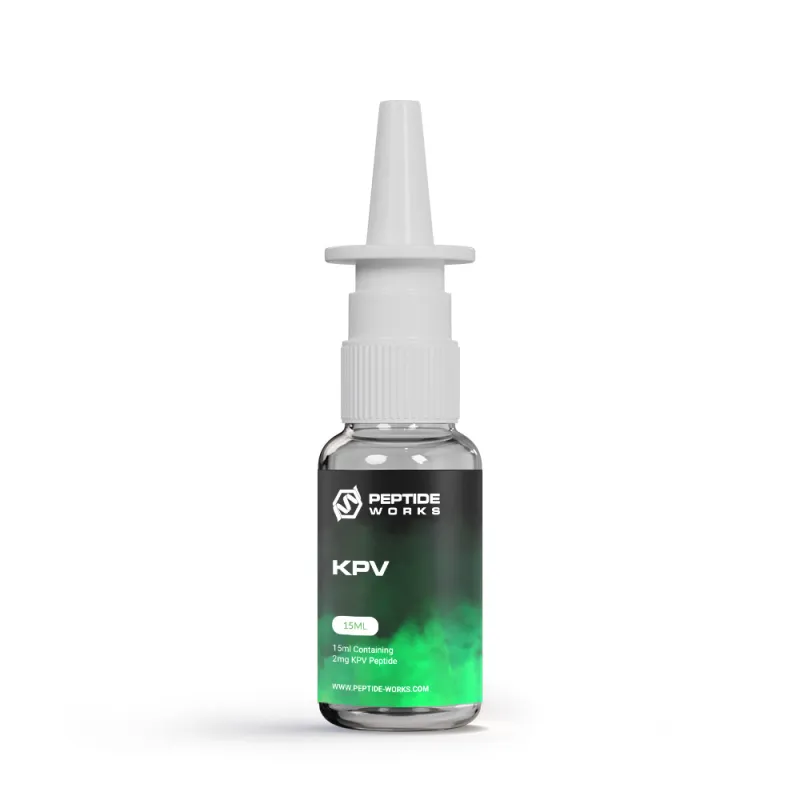
Buy KPV Nasal Spray In Europe
Where to buy KPV Nasal Spray in the EU? From our EU warehouse with 48H delivery to UK, Germany, France and across Europe.
Studying gut and immune peptide pathways? Get KPV Nasal Spray in Europe ready to use.
At Peptide Shop Europe we supply lab-grade KPV in a sterile nasal spray solution. No reconstitution needed, every bottle ships with full COA.
Can I purchase KPV Nasal Spray online? Yes. You can order KPV Nasal Spray, shop KPV research peptide, or get KPV nasal solution from EU stock today.
Researchers across Europe trust Peptideshopeurope.com to purchase high-purity KPV Nasal for inflammation and gut health studies. Verified purity, discreet shipping, and fast dispatch so you can stock your lab with KPV Nasal Spray in Europe.
KPV Nasal Spray: Overview
KPV Nasal Spray refers to an experimental nasal formulation associated with KPV (Lys-Pro-Val), a three-amino-acid peptide corresponding to the C-terminal sequence of α-melanocyte-stimulating hormone (α-MSH).
KPV has attracted research interest primarily because of reported anti-inflammatory and immunomodulatory effects in laboratory and animal models. Research has examined its potential interactions with inflammatory signaling, epithelial cells, and gastrointestinal biology.
The term nasal spray describes the proposed delivery route. It does not establish that a particular KPV nasal formulation has demonstrated adequate human absorption, clinical effectiveness, safety, or regulatory approval.
What Is KPV Nasal Spray?
KPV consists of three amino acids:
K = Lysine
P = Proline
V = Valine
It represents the C-terminal tripeptide of α-MSH, a naturally occurring melanocortin peptide.
Research into KPV has explored whether some biological properties associated with α-MSH can be retained in this much smaller peptide. Particular attention has been given to inflammatory pathways and epithelial responses.
A KPV nasal spray is therefore best described as an experimental peptide-delivery formulation rather than an established nasal medicine.
KPV Nasal Spray: How It Works
The precise mechanism of KPV remains an active area of research.
Experimental studies have reported effects involving inflammatory signaling pathways such as NF-κB, a transcription factor that regulates the expression of numerous inflammatory mediators.
A simplified research model is:
KPV → modulation of inflammatory signaling → altered inflammatory mediator activity
However, KPV’s biological mechanism should not be reduced to a single receptor pathway. Its effects may depend on the tissue, concentration, experimental conditions, and surrounding inflammatory environment.
KPV and α-MSH
KPV is structurally related to α-MSH but should not be considered equivalent to the complete hormone.
α-MSH is involved in several physiological processes, including melanocortin signaling, pigmentation, and immune regulation.
KPV corresponds only to the peptide’s C-terminal sequence. Researchers have therefore investigated whether KPV can reproduce selected biological activities without being the full α-MSH molecule.
KPV Nasal Spray and Inflammatory Research
Inflammation is one of the primary areas of KPV research.
Laboratory studies have investigated KPV in models involving inflammatory stimulation and have reported effects on inflammatory signaling and cytokine-related responses.
This has generated interest in potential research applications involving:
- Inflammatory signaling
- Epithelial biology
- Immune regulation
- Gastrointestinal inflammation
- Tissue-barrier function
These findings remain primarily preclinical and should not be interpreted as proof that KPV nasal spray treats inflammatory disease in humans.
KPV Nasal Spray and Gastrointestinal Research
KPV has received particular attention in experimental gastrointestinal research.
Studies involving intestinal epithelial cells have examined whether KPV can influence inflammatory responses and cellular signaling. Other experimental work has investigated its relationship with epithelial barrier function and intestinal inflammation.
These findings provide a scientific rationale for further investigation, but they do not establish KPV as an approved treatment for Crohn’s disease, ulcerative colitis, irritable bowel syndrome, or other gastrointestinal disorders.
Nasal Delivery of KPV
The nasal route is of interest for peptide delivery because the nasal mucosa provides a potentially useful absorption surface.
However, peptide delivery through the nose is influenced by several factors, including:
- Peptide stability
- Molecular size
- Nasal enzymatic activity
- Mucosal clearance
- Formulation composition
- Concentration
- Spray-device characteristics
- Individual nasal physiology
Consequently, evidence obtained from one KPV formulation cannot automatically be applied to every product described as a KPV Nasal Spray.
KPV Nasal Spray: Research Applications
Inflammatory Biology
KPV is investigated as a model for understanding how small peptides can influence inflammatory signaling.
Gastrointestinal Research
Experimental studies have examined KPV in relation to intestinal epithelial responses and inflammatory processes.
Immune-Modulation Research
KPV’s relationship to α-MSH has prompted investigations into potential immunomodulatory effects.
Barrier-Function Research
Researchers have examined whether KPV can influence cellular pathways associated with epithelial integrity.
Peptide Delivery Research
A nasal formulation provides another experimental approach for studying delivery of small biologically active peptides.
Evidence and Limitations
The available evidence for KPV is predominantly preclinical.
Important limitations include:
- Human clinical evidence remains limited.
- The pharmacokinetics of intranasal KPV are not well established.
- Optimal nasal formulations have not been universally defined.
- Long-term safety data are insufficient.
- Different formulations may produce different exposure levels.
- Animal and cellular findings cannot automatically be extrapolated to humans.
For these reasons, claims that KPV Nasal Spray is clinically proven to treat inflammation, gastrointestinal disease, skin conditions, or other medical disorders would exceed the current evidence.
Product Quality and Documentation
For an experimental nasal peptide preparation, product-specific documentation is important.
Useful information may include:
- KPV identity
- Peptide sequence
- Concentration
- Purity analysis
- Batch or lot number
- Formulation ingredients
- Manufacturing information
- Stability data
- Nasal-delivery specifications
- Storage requirements
- Expiration or retest date
- Certificate of analysis, where available
A certificate of analysis can provide batch-specific analytical information but does not independently establish clinical effectiveness or regulatory approval.
Safety and Important Considerations
The fact that KPV is derived from a naturally occurring peptide sequence does not establish that every KPV formulation is safe for human use.
Important uncertainties include:
- Nasal mucosal tolerability
- Systemic absorption
- Pharmacokinetics
- Dose-response relationships
- Long-term exposure
- Product purity
- Formulation stability
The safety profile of a specific nasal preparation also cannot be inferred from laboratory studies involving KPV administered through a different route.
Regulatory Status
A product marketed as KPV Nasal Spray should not automatically be considered an approved pharmaceutical medicine.
The existence of scientific research demonstrating biological activity does not constitute regulatory approval. Regulatory status depends on the exact formulation, manufacturer, intended use, and jurisdiction.
It is therefore important to distinguish KPV as an experimental research peptide from any particular commercial nasal product.
Frequently Asked Questions About KPV Nasal Spray
What is KPV Nasal Spray?
It is a nasal-delivery formulation associated with KPV, a three-amino-acid peptide consisting of lysine, proline, and valine.
What does KPV stand for?
KPV represents the amino-acid sequence Lys-Pro-Val.
Where does KPV come from?
KPV corresponds to the C-terminal tripeptide sequence of α-MSH.
What is KPV being researched for?
Research has focused mainly on inflammatory signaling, intestinal epithelial biology, immune modulation, and barrier-function pathways.
Is KPV the same as α-MSH?
No. KPV is only a short three-amino-acid sequence derived from α-MSH and does not have the same molecular structure as the complete peptide.
Is KPV Nasal Spray an approved medicine?
A product marketed specifically as KPV Nasal Spray should not automatically be considered an approved medicine. Its regulatory status depends on the exact formulation and jurisdiction.
Scientific References and Informative Sources
- PubMed — KPV and Inflammatory Signaling Research
- PubMed — KPV and Intestinal Inflammation Research
- NCBI — Melanocortin Peptides and Physiology
- FDA — Unapproved Drugs
Summary
KPV Nasal Spray is an experimental nasal formulation associated with KPV, a tripeptide consisting of lysine, proline, and valine and derived from the C-terminal region of α-MSH.
Laboratory and animal research has investigated KPV in relation to inflammatory signaling, gastrointestinal epithelial biology, immune responses, and barrier function. However, evidence specifically establishing the safety, pharmacokinetics, or clinical effectiveness of KPV delivered through a nasal spray remains limited.
For accurate scientific and product information, KPV Nasal Spray is therefore best characterized as an experimental peptide formulation, with claims about therapeutic benefits kept separate from findings demonstrated in controlled human clinical research.
ALL CONTENT AND PRODUCT INFORMATION AVAILABLE ON THIS WEBSITE IS FOR EDUCATIONAL PURPOSES ONLY.
DISCLAIMER: Products are supplied for research purposes only and are not intended to diagnose, treat, cure, or prevent any disease.